Lessons From a Little Mountain Goat

One of the greatest gifts of living in the Okanagan and Similkameen in the spring is witnessing the vibrant explosion of Arrowleaf Balsamroot across the valleys. By late April and early May, the grasslands glow with golden flowers stretching across the hillsides. These flowers are more than just beautiful, they play an important role in sustaining the wildlife that call these valleys home.

A few years ago, my dad and I were hiking through a high-elevation grassland when we noticed many of the balsamroot plants had their tops eaten off by mule Deer and mountain goats.
I learnt that ungulates like deer, elk, and mountain goats play an important role in the ecology of the Arrowleaf Balsmroot, helping with things such as seed dispersal, natural fertilizer and grazing balance. The Arrowleaf Balsamroot evolved alongside grazing animals over thousands of years. These relationships are part of a balanced ecosystem.
After that day, I imagined how incredible it would be to photograph a white mountain goat standing amongst those bright yellow flowers.
So one spring, I headed back up a mountain where I knew goats frequented the grasslands. From the highway below, I could already spot them feeding high in these grasslands abundant with Balsmroot.
After the climb, I settled in and watched a small group of nanny goats carefully feeding in the open slopes. Even while grazing, they never fully relaxed, always keeping one eye on the cliffs behind them and another on the landscape for predators. I knew they would be timid this far from the safety of the rocks.
I positioned myself behind a small knoll where I could stay mostly hidden while still watching them move slowly uphill as they fed on the flower tips.
About an hour later, it finally happened.

One nanny goat walked directly in front of me, no more than fifty feet away. With perfect precision, she plucked the flower head from an Arrowleaf Balsamroot. The moment I lifted my camera and pressed the shutter, she looked up at me with the yellow flower perfectly hanging from her mouth like a kid caught sneaking cookies from the jar.
The expression on her face was priceless.
She paused for a moment, studied me, and quickly decided I wasn’t a threat. Maybe she simply assumed I was there enjoying the flowers too. Then, without concern, she continued feeding her way down the mountainside while I sat there grinning behind the camera.
To this day, it remains one of my favourite wildlife encounters and one of my top-selling photographs because it tells a deeper story of the relationship between ungulates, grasslands, and the fragile balance that keeps these ecosystems healthy.
For the last three years, that moment has replayed in my mind each spring. Two of my favourite things about living here are the mountain goats and Arrowleaf Balsamroot. Seeing the two together felt like the perfect reflection of this landscape I love so much.
This spring, I decided to return and try to relive that experience.
The flowers had bloomed only days earlier, and I climbed the same mountain hoping once again to photograph goats feeding amongst the yellow hillsides. But to my surprise, the goats seemed mostly uninterested in the flowers this time around, which puzzled me for much of the day. Maybe there was a predator in the area that the goats were avoiding?
While standing on top of the mountain I started glassing across the drainage, I spotted several goats high among the cliffs on the opposite slope. The climb to reach them looked brutal, nearly 1,500 feet straight up loose rock and shale. But the chance to photograph a mountain goat perched above the valley was enough motivation for me to start climbing.

It didn’t take long for reality to set in.
As I ascended the mountain, I quickly realized I wasn’t in the same shape I had been a few years ago when I was ultra trail racing. After dealing with a lingering leg injury for the past year and a half, every steep step burned more than I wanted to admit.
Still, I kept moving upward, one foot at a time.
About halfway up, I found a small flat spot where I could safely take off my pack and catch my breath. As I reached for my water bottle, I caught movement behind me.
A young yearling mountain goat was slowly approaching.
Our eyes locked, and for a moment we simply studied one another, both unsure what the next few minutes would become. Curiosity quickly overcame the little goat’s fear, and she cautiously moved closer.

One thing wildlife photography has taught me over the years is never to behave like a predator. No sudden movements. No direct pressure. No forcing the encounter.
So I looked away and pretended not to care too much about her presence.
That only made her more curious.
Before long, she stood less than forty feet away. I slowly lifted my camera and quietly began photographing her while trying not to interrupt the moment unfolding between us.
For nearly ten minutes we shared the mountainside together before I decided it was time to continue climbing.
Not long after, I stopped again to catch my breath on another steep section of rock. Then I heard stones shifting behind me.
I turned around.
There she was again.
The little goat had followed me up the mountain.

I sat back down and looked at her. She looked back at me. Neither of us seemed entirely alone anymore on that steep mountainside.
It reminded me of the way a young dog follows someone simply because it feels safe beside them.
I laughed quietly to myself. “Alright,” I thought, “maybe we don’t need to rush this climb.”
That’s always been one of my struggles. I rush everything.
Ever since I was young, I’ve lived with urgency. Chores, work, running races or climbing mountains, I’ve always felt the need to move faster, finish quicker, accomplish more. I grew up hearing my dad say, “Light a fire under it!” In other words: MOVE! We’ve got stuff to do!
But sitting there beside that little goat, something shifted.
She wasn’t in a hurry to reach the top of the mountain. She simply wanted to sit, observe, and exist in the moment. Maybe she was trying to understand me. Or maybe the mountain was trying to teach me something through her.
So I stopped fighting the pace of the day.
I stayed still.
Eventually, the little yearling walked over to a patch of soft dirt and carefully bedded down about twenty-five feet away from me. She pawed at the soil, kicking away the hot top layer to cool herself while also creating a secure place to rest on the steep slope.

Then she relaxed and began chewing her cud.
That was the moment I knew she felt safe.
As strange as it sounds, an overwhelming sense of calm washed over me. The same comforting feeling I get when my cat Minnie curls up nearby and starts to purr. A quiet sense of trust. A connection without words.
And sitting there beside that goat, I realized something. Maybe the mountain wasn’t asking me to conquer it that day. Maybe it was asking me to slow down enough to actually experience it.
Because when we spend our lives rushing toward the destination, we often miss the very moments that make the journey meaningful.
About thirty minutes later, I felt my energy return. The little goat remained bedded in the dirt while I slowly stood up and continued my climb, this time without urgency. I wasn’t trying to beat the mountain anymore. I was simply moving through it.
I never did find the other goats again. The afternoon heat had pushed them deep into the cliffs for shelter. By the time I reached the summit, my feet were covered in hot spots and the beginnings of blisters.
I dropped my pack, pulled off my boots and socks, and stood barefoot on the mountain.
For me, there’s something deeply grounding about feeling of the earth beneath my bare feet after a hard climb while at the summit of a mountain. My Auntie Sally taught me that years ago when reaching the top of a mountain to slow down and take your boots off to reconnect, and let the mountain calm your nervous system.
After I enjoyed a bite to eat and combined with the cool updraft rolling over the summit, my energy felt restored almost instantly.
I took a quick summit photo selfie and then decided against descending the dangerous shale face I had climbed. Instead, I looped around through the douglas fir forest and made my way back toward the grasslands below.
And this time, I explored slowly.
I wandered through fresh green grasses and young Aspen leaves trembling in the wind while Blue Grouse drummed in the distance through the timber. The entire mountain felt alive.
Then, crossing a rolling hillside covered in Arrowleaf Balsamroot, I caught a flash of white between the flowers.
An elk shed.
A beautiful six-point antler, sun-bleached bright white, lying perfectly amongst the yellow blooms.
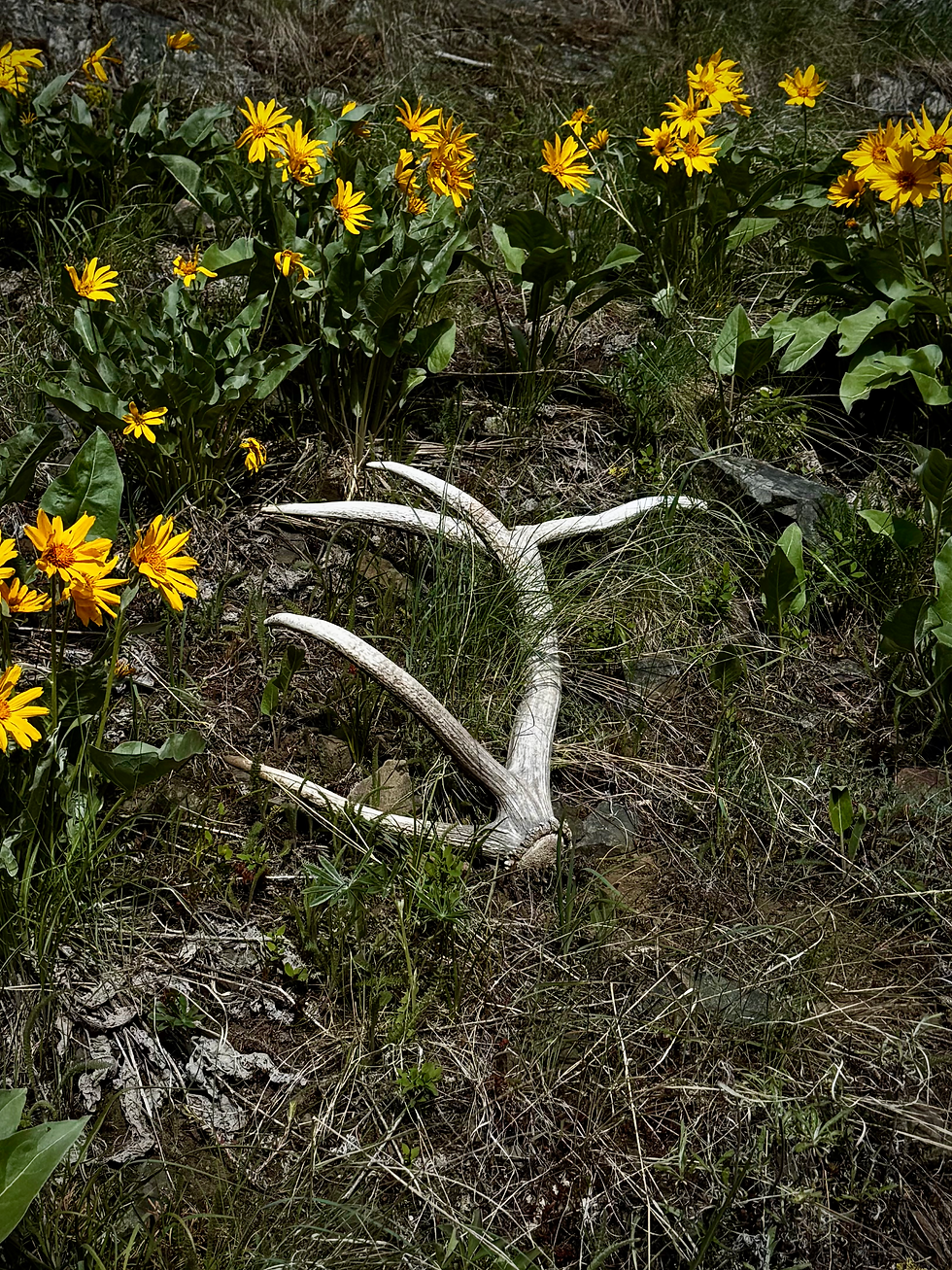
For years I had searched these mountains for a shed like that, following elk sign and old rubs with no luck. Yet here it was, waiting for me on the very day I finally stopped rushing through the landscape.
And I couldn’t help but wonder… “If I had stayed focused only on finishing the hike, would I have walked right past it?””
I strapped the antler to my camera bag and began descending the grassy slopes toward my truck. I couldn’t tell what was glowing brighter, the golden flowers lit by the late afternoon sun or the grin stretched across my face after such an unforgettable day.
By the time I returned to the truck, my legs were exhausted, my body dehydrated, and my feet sore from descending nearly 3,000 vertical feet in the heat.
But none of that mattered.
What stayed with me was the lesson that little mountain goat gave me high on the cliffs.
Slow down.
You do not have to race to the summit to find meaning in the mountain.
Sometimes the greatest gifts waiting for us are only found when we move slowly enough to notice them. A quiet connection, a moment of trust, a lesson carried on the wind, or an unexpected treasure resting amongst the flowers.
The mountain will always be there. The challenge is learning how to truly be there with it.
And for that lesson, I’ll always be grateful to that little mountain goat who chose to share her mountainside with me.